RO vs UV vs UF Water Purifier Guide India: Which One to Choose?
RO, UV, and UF water purifiers serve different needs based on Indian water quality. RO removes dissolved salts, UV kills microbes, and UF filters particles. Choose depending on your local water and budget.
Contents
- Water-treatment decision table
- What is the difference between RO, UV, and UF water purifiers?
- How do RO, UV, and UF purifiers work to clean water?
- Which type of water purifier is best for Indian tap water?
- What are the advantages and disadvantages of RO, UV, and UF water purifiers?
- Which water purifier is most cost-effective and what maintenance is required?
- Can RO, UV, and UF purifiers remove all contaminants found in Indian water?
- How do regional water quality variations in India affect the choice between these purifiers?
- What health considerations should Indian consumers keep in mind when choosing a water purifier?
- Frequently asked questions
- The bottom line
- Sources & methodology
RO, UV, and UF water purifiers differ in how they clean water, making each suitable for specific types of Indian water. RO purifiers remove dissolved salts and heavy metals, ideal for high-TDS water. UV purifiers disinfect bacteria and viruses but do not remove solids or salts. UF purifiers filter out suspended particles and bacteria but not dissolved salts. Selecting the right purifier depends on your water source, contamination, budget, and maintenance preferences.
Water-treatment decision table
| Water concern | Technology to investigate | Important limitation |
|---|---|---|
| Dissolved salts or high TDS | RO | Creates reject water and needs maintenance |
| Microbiological risk | UV with suitable pre-filtration | Does not remove dissolved salts |
| Suspended particles | UF or sediment filtration | Does not solve every chemical or dissolved contaminant |
| Uncertain supply | Laboratory water test first | Do not choose from TDS alone |
Choose treatment from a current water-quality report, not marketing claims. Annual cost should include filters, membranes, service visits and expected reject-water use.
What is the difference between RO, UV, and UF water purifiers?
The key differences lie in their filtration mechanisms and the impurities they target. RO (Reverse Osmosis) uses a semipermeable membrane to remove dissolved salts, heavy metals, and chemical contaminants. UV (Ultraviolet) purifiers disinfect water by killing bacteria, viruses, and pathogens using ultraviolet light but do not remove dissolved solids. UF (Ultrafiltration) uses a fine membrane to trap suspended particles, bacteria, and cysts without affecting dissolved salts. Each technology addresses different contamination challenges found in Indian water.
How do RO, UV, and UF purifiers work to clean water?
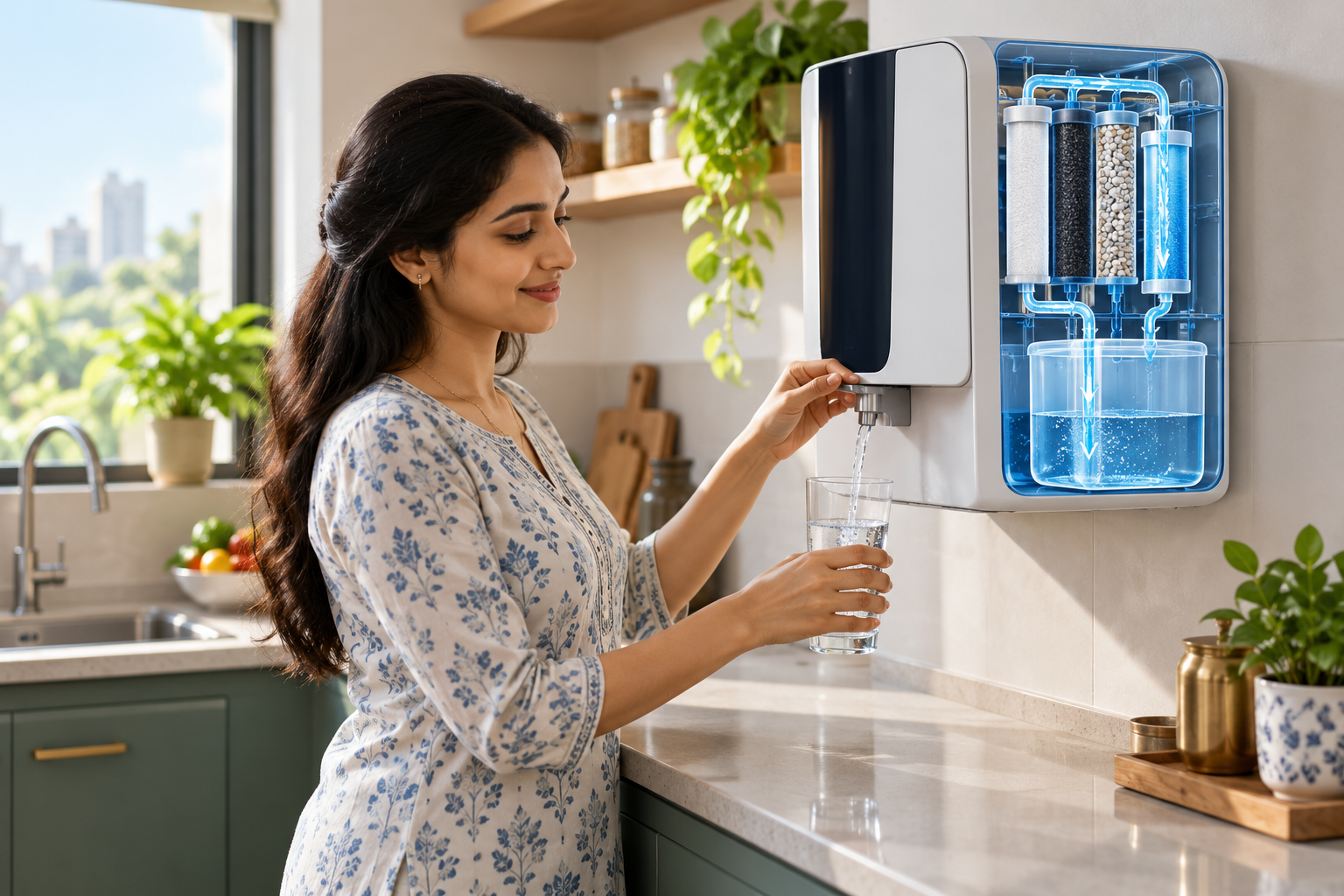
- RO: Water is forced under pressure through a semipermeable membrane that allows only pure water molecules to pass, leaving behind dissolved salts, heavy metals, and other contaminants.
- UV: Water flows through a chamber exposed to ultraviolet light that damages the DNA of microbes, killing bacteria and viruses without removing solids or chemicals.
- UF: Water passes through ultrafiltration membranes with microscopic pores that trap suspended solids, bacteria, and cysts but let dissolved salts and very small particles pass through.
Which type of water purifier is best for Indian tap water?
The choice depends largely on your water's Total Dissolved Solids (TDS) level and microbial contamination:
- RO: Best for water with high TDS—common in borewell water and some municipal supplies contaminated with dissolved salts, heavy metals, or chemicals.
- UV: Suitable when water has microbial contamination but low TDS, such as treated municipal water supply.
- UF: Ideal for water with low TDS but potential suspended solids or bacterial contamination, often in rural or river-sourced water.
- Combination Units: RO+UV or UV+UF purifiers offer broader protection for complex contamination involving both dissolved solids and microbes.
What are the advantages and disadvantages of RO, UV, and UF water purifiers?
| Technology | Advantages | Disadvantages |
|---|---|---|
| RO | Removes almost all contaminants including salts, heavy metals, and microbes; provides purified water. | Wastes 2-3 times more water; requires electricity; removes beneficial minerals; higher maintenance cost. |
| UV | Cleans pathogens chemically-free; retains dissolved salts and minerals; saves water as no wastage; moderate cost. | Does not remove dissolved solids or chemical pollutants; needs electricity; lamp replacement needed annually. |
| UF | No electricity required; conserves water; retains essential minerals; simple maintenance. | Less effective against viruses and dissolved salts; unsuitable for high-TDS water. |
Which water purifier is most cost-effective and what maintenance is required?
Cost and upkeep vary by technology:
- RO purifiers have higher upfront costs, require electricity, and waste water. Membranes typically need replacement every 1–2 years.
- UV purifiers come at moderate cost; lamps must be replaced roughly every year to maintain effectiveness.
- UF purifiers are the most economical, require minimal maintenance, and do not use electricity. Filters generally last longer and need less frequent replacement.
Can RO, UV, and UF purifiers remove all contaminants found in Indian water?
No single purifier removes all types of contaminants commonly found in India. RO removes dissolved salts, heavy metals, and microbes but wastes water. UV kills pathogens effectively but leaves dissolved solids and chemicals untouched. UF removes suspended solids and bacteria but does not remove dissolved solids or viruses reliably. Combinations like RO+UV are often recommended for comprehensive purification.
How do regional water quality variations in India affect the choice between these purifiers?
- Northern India: Often has hard, high-TDS water needing RO technology.
- Urban areas: Municipal water supplied is generally treated; UV or UF purifiers suffice for microbial safety and particle removal.
- Rural or river-sourced water: Microbial contamination is common, so UV or UF is more appropriate.
- Testing local water quality before selecting a purifier is advised to choose the suitable technology.
What health considerations should Indian consumers keep in mind when choosing a water purifier?
- RO purifiers remove essential minerals from water, so some users prefer models with mineralizers or add supplements to maintain health.
- UV purifiers ensure the water is free from microbes but do not remove chemical pollutants; additional treatment may be necessary if chemicals are present.
- UF purifiers preserve minerals but may not be reliable against viruses, which could pose health risks.
- Consult water quality reports or health experts if in doubt about the suitability of a purifier for your water source.
Frequently asked questions
Do all water purifiers require electricity to operate?
Not all. RO and UV purifiers need electricity to function, while UF purifiers operate without electricity, making UF more suitable for areas with unreliable power supply.
Can RO water purifiers waste a lot of water?
Yes, RO purifiers typically waste 2 to 3 times the purified water amount as reject water, which can be reduced by models designed with better efficiency.
How often should the filters and membranes be replaced in different types of purifiers?
RO membranes generally require replacement every 1 to 2 years, UV lamps annually, and UF filters less frequently, depending on water quality and usage.
Are combined RO+UV+UF purifiers better than individual ones?
Combined purifiers provide layered protection against a wider range of contaminants—salts, microbes, and suspended particles—making them suitable for complex water quality issues common in India.
Is it necessary to test my home water before buying a purifier?
Yes, testing your local water helps identify contaminants and select the most effective purifier technology, potentially saving costs and ensuring health safety.
The bottom line
Choosing between RO, UV, and UF water purifiers depends on your local water quality, especially TDS levels and microbial risk. RO purifiers suit high-TDS water but waste water and electricity. UV purifiers disinfect microbes in low-TDS water effectively but don't remove dissolved solids. UF purifiers are economical and chemical-free but less effective against viruses and dissolved salts. Combining technologies or testing your water quality first ensures the best fit for your Indian home.
For more detailed buying advice, explore our Consumer Buying Guides for Indian households. If interested in improving your home's overall comfort, consider reading about Modular Kitchen Cost in India: Complete 2026 Price Guide or Small 2BHK Storage Ideas That Make Indian Apartments Feel Bigger.
Sources & methodology
We reviewed the primary references below when checking the time-sensitive facts in this guide. Product features, prices, rules and eligibility can change, so confirm important details with the linked authority before acting.
- WHO drinking-water fact sheet who.intPrimary public-health context for safe drinking water.
- Bureau of Indian Standards bis.gov.inOfficial Indian standards authority; verify applicable drinking-water and purifier standards.